For Dave Gibbs, American football has never been just about playbooks, formations, or what the scoreboard says at the final whistle. It’s always been about something bigger. About building a sport, shaping a culture, and creating something people genuinely want to watch, support, and feel connected to.
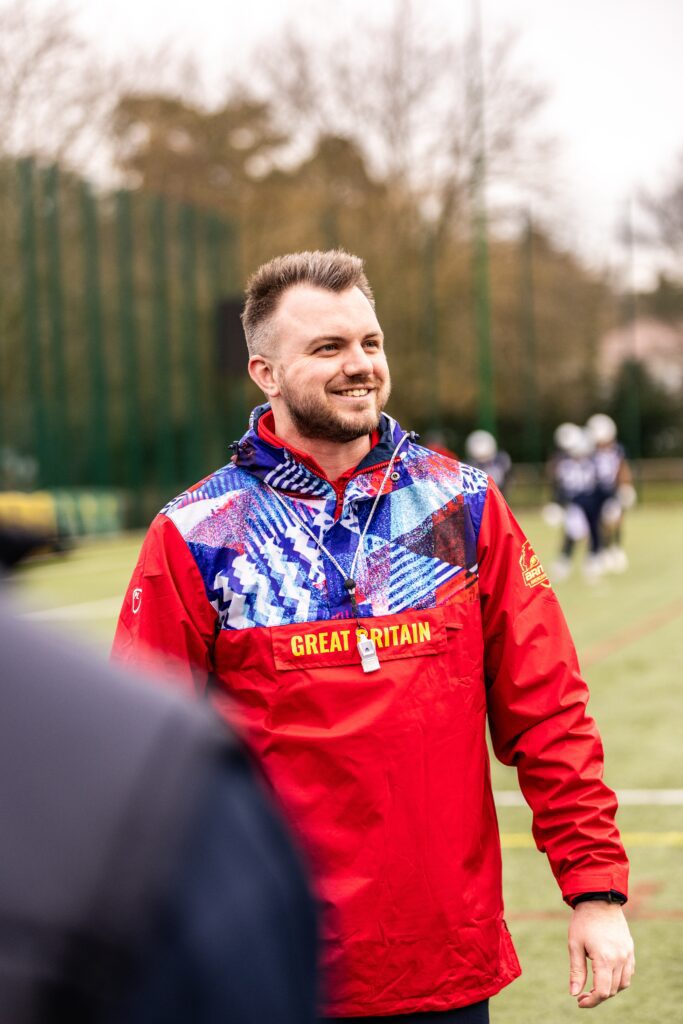
That outlook has carried Gibbs from a childhood introduction to the game in the United States, through a career-altering run of injuries, and into his current role as Offensive Coordinator for Great Britain’s men’s national team. Along the way, it has formed a coaching philosophy rooted not simply in winning games, but in long-term growth of players, coaches, and the sport itself across the UK.
From Curiosity to Commitment
Gibbs’ introduction to American football wasn’t planned. It was circumstantial. After moving to Northern Virginia at the age of eight, he found himself immersed in a sporting culture where the NFL wasn’t a niche interest, but a national fixation.
“I’d never interacted with American football before,” he told Fen Regis Trophies. “I was into football and rugby back then. But over there, that was what everyone cared about — so it’s where I gravitated.”
That first hook came via a Super Bowl — watched with little understanding of rivalries or geography, but enough intrigue to spark a lasting interest. Youth football followed, but a return to the UK soon interrupted that momentum.
At the time, opportunities were sparse. There were no clear pathways, no obvious routes for young players to stay involved. What had started to build overseas was effectively put on pause.
It would be years before Gibbs properly reconnected with the sport, eventually doing so through university football, where success came quickly — including a national championship with the University of Birmingham.
That chapter wouldn’t last as long as he’d hoped.
The Shift from Player to Coach
A series of knee injuries forced Gibbs to confront a reality most athletes struggle to accept: playing wasn’t going to be a long-term option. Coaching, at first a necessity, soon became something more.
“I started coaching at 19, mostly copying what my coaches had done before,” he says. “It took time to develop my own identity — to really think about how I wanted the game to be played.”
That identity has changed dramatically over time. Gibbs’ early football education was steeped in traditional, run-heavy systems — offences rooted firmly in the game’s past. Today, his approach is unmistakably modern: spread formations, smart ball distribution, detailed receiver development, and explosive plays designed not just to score points, but to capture attention.
That distinction, he believes, matters more than ever.
Why Watchability Matters
In a country where American football still lives on the fringes of the sporting mainstream, Gibbs is clear that entertainment isn’t a luxury — it’s a necessity.
“The success metric of sport isn’t participation,” he says. “It’s fans. Fans create everything else.”
For Gibbs, that means building teams and systems that mirror what casual viewers recognise and enjoy — the fast, aggressive, attacking football seen on television every weekend. It’s a conscious effort to narrow the gap between what British audiences see on NFL broadcasts and what they experience at domestic games.
“If people enjoy watching it, they’ll come back. They’ll bring others. And eventually, that’s how the sport becomes sustainable.”
That philosophy runs through everything he does, from his work at club level to his responsibilities with the national programme.
The National Stage
Gibbs joined the Great Britain men’s setup in 2021 as a general assistant. Since then, he has progressed steadily, earning trust and responsibility before stepping into the role of Offensive Coordinator.
The difference, he says, is felt immediately.
“With the national team, the calibre of athlete is different. There are things I can do schematically with GB that just aren’t possible at club level.”
Recent selection camps drew more than 400 athletes — evidence of the sport’s growing depth in the UK, even if resources remain limited. That tension, between ambition and constraint, is a familiar theme in British American football.
Still, moments like the 2023 away victory in Denmark — which Gibbs cites as his proudest coaching achievement — underline what can be achieved.
“Winning away in international football is hard,” he says. “Doing it with a group of largely amateur and semi-professional players makes it even more special.”
Growing the Game, Not Just Teams
What separates Gibbs from many coaches is how he defines success. Conversations with him rarely drift towards personal accolades or short-term outcomes. Instead, they circle back to infrastructure, accessibility, and sustainability.
He points to the rapid growth of flag football in the UK — driven by its accessibility and its inclusion in the LA 2028 Olympic Games — as a genuine opportunity.
“Kids can now start at six or seven,” he explains. “Flag removes the cost and equipment barriers. It’s how we grow the base.”
From there, the pathway becomes clearer: flag football into contact, youth into academy, academy into senior programmes. It’s a structure that simply didn’t exist when Gibbs first returned from the US — and one he’s determined to help improve.
Facilities remain a challenge. Purpose-built American football fields are rare, and teams continue to rely on shared spaces and creative solutions. But Gibbs sees that as part of the sport’s British identity — resourceful, adaptable, and quietly ambitious.
Process Over Promises
Ask Gibbs about the next five years, and you won’t get sweeping predictions or easy headlines. Instead, he talks about process.
“I don’t set performance-based goals,” he says. “I focus on doing the right things consistently.”
For him, that means improving financial stability, reducing reliance on player fees, raising coaching standards, and creating an experience that feels worth buying into — whether you’re pulling on pads, standing on the sideline, or watching from the stands.
Results still matter. European qualifiers are coming. Championship cycles are on the horizon. But for Gibbs, those outcomes are the by-product, not the mission.
The mission is growth — steady, sustainable, and grounded in the belief that British American football can be more than it is right now.
And if it gets there, it will be because people like Dave Gibbs kept asking not just how to win games — but how to build something worth watching.
By Aaron Gratton